Our beliefs
The state of agriculture as we see it, in France and around the world, and why we decided to create Neayi.
This is the first article in a series about Neayi. In it, we explain the state of agriculture as we see it, in France and around the world. That is why we decided to create Neayi: to start answering the tremendous challenges we see.
Update (24 June 2019) — The second article in this series is here!
Links in this article point to sources, most of them in French.
Agriculture is going through a many-sided crisis
Pollution, loss of trust, health risks, debt, regulations, species extinction, awareness that the world’s resources are limited… The solutions to these problems overlap and collide. For example, the mad cow crisis brought feeding livestock with animal meal to an abrupt halt, creating a huge demand for soya and maize (two of the most energy-rich plants per kilo), which led to massive deforestation of South America’s primary forests.
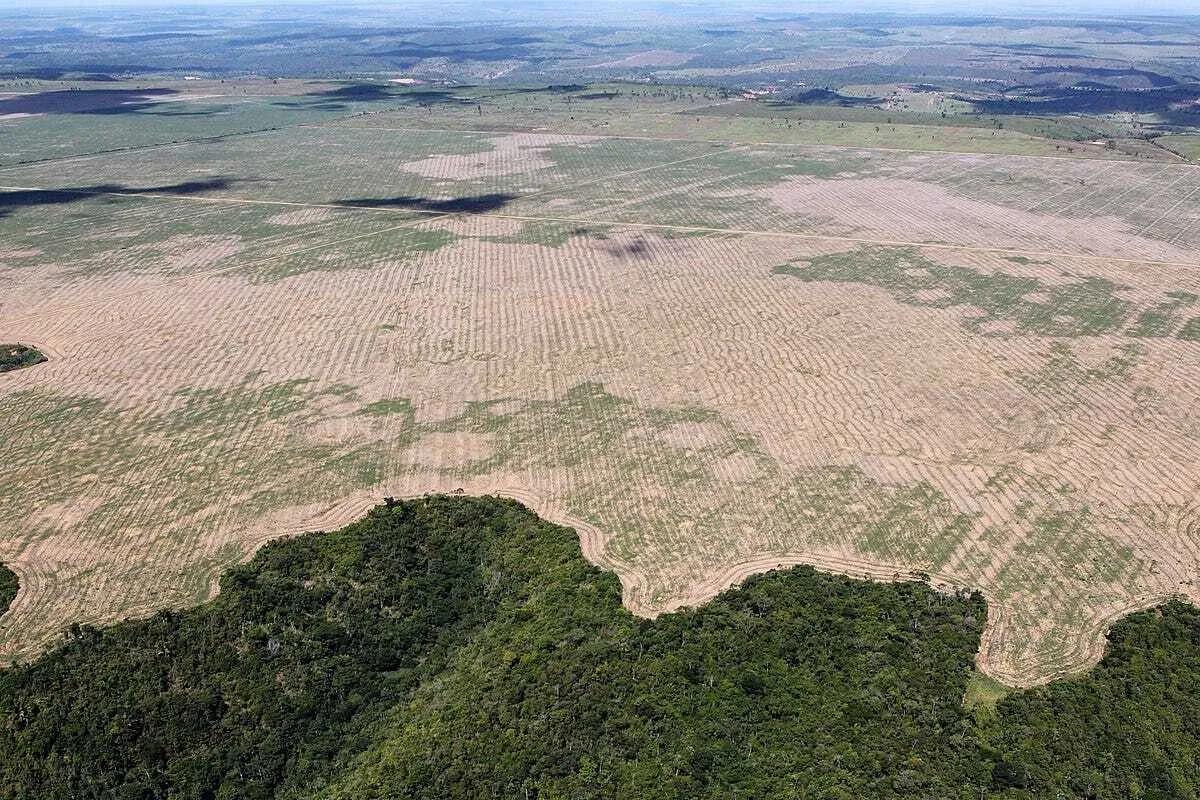 Deforestation of the Amazon rainforest
This deforestation increases CO2 emissions, on top of emissions of methane (ruminants, rice) and nitrous oxide (fertilisers), which have respectively 30 and 300 times the warming power of CO2. In total, world agriculture accounts for 24% of all greenhouse gas emissions driving global warming.
https://reporterre.net/Climat-l-agriculture-est-la-source
We now know that this warming in turn poses a serious threat to agriculture: droughts, floods, hail, early springs followed by frost, pest migrations, new diseases. Each additional degree cuts global yields by 7%.
This drop in yields comes at the same time as world population grows (from 7 billion today to 9 billion by 2030), requiring production to rise by at least 30 to 50%. Moreover, as living standards rise, countries such as China are radically changing their diets and turning to far more protein-rich food.
By 2030, melting Himalayan glaciers are expected to dry up 10 of the world’s largest rivers for several months each year (including the Ganges, the Indus, the Yellow River and the Mekong), rivers that directly supply both the farming and the hydroelectric power of several billion people.
Caught between a rock and a hard place, populations spared by drought will be hit by floods. In Bangladesh, for instance, rising waters will wipe out 20% of the country, forcing mass migration to neighbouring countries.
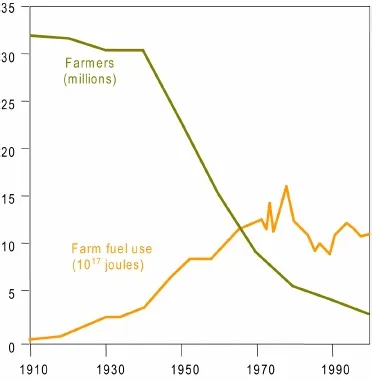 Number of farmers in the United States and farm fuel use, 1910 to 2000
The threats do not come from global warming alone. Peak oil, signalling the beginning of the end of oil, happened in 2006 in Europe for conventional oil and is expected by 2030 for all hydrocarbons. Farming is extremely dependent on fossil fuels: to produce and spread fertilisers and pesticides, to work the soil, to store and transport raw materials. It takes about 1,500 litres of oil to “produce” a 500 kg cow. Without oil, or even with oil at twice the price, we simply do not know how to keep our food system running.
Beyond peak oil, peak phosphorus is looming. Phosphorus is one of the three elements plants need to grow (with nitrogen and potassium). No phosphorus, no agriculture. Yet phosphorus has no “renewable” equivalent. Unless we find a way to use it more efficiently (today only 15% of the phosphate spread on farmland ends up in plants; the rest runs off into rivers and lakes, causing new pollution, blue-green algae in particular), our food production system is doomed.
Finally, water shortage, as groundwater levels keep falling, is an increasingly worrying threat, especially in countries with the fastest-growing populations.
Faced with this, French farmers are divided
Conventional agriculture, faithful to the model set by post-war European policy, keeps delivering on its contract: produce as much as possible. But it operates in an ever more regulated framework, which narrows both the treatments allowed and the room for innovation, itself heavily dependent on debt and on the specific subsidies it can obtain. Widespread consumer distrust of the food industry, and a lack of support and understanding from policymakers, have created a toxic climate in which nobody listens to anyone any more.
Organic farming, born of the excesses of the agrochemical industry, is trying to define a new model in opposition to the first. But limited yields, sensitivity to pests and weather, and the immense complexity of fighting with natural products, which are also less precise and less effective, make this agriculture dependent on aid and subsidies. When that aid is late, as it has been for several years now, the system breaks down.
Conventional or organic, agriculture faces international competition that is sometimes unfair. Conventional farmers in neighbouring countries are not bound by the same limits on GMOs or on certain products. Organic farming does not follow the same specifications in Eastern Europe and in France. While glyphosate is being phased out, imports of soya and maize are growing through free-trade agreements: soya and maize from GM plants sprayed directly with glyphosate (increasing residues), grown on deforested land.
Consumer expectations on these issues are not always matched by consistent changes in behaviour. Habits built over the past forty years (fruit and vegetables from every country, in every season, flawless in colour and appearance, at ever lower prices) are hard to change. As with vaccines, the food safety we take for granted makes us question certain additives (nitrites, for example, added to prevent botulism, listeria or salmonella).
Farming practices will have to change
People say the farming sector is slow to change. But they are wrong about why. It is not for lack of will or entrepreneurship among farmers. They did not wait for government recommendations to adapt and look for new ways of working, as organic, agroecological, permaculture and agroforestry initiatives show.
What is slow to change is the soil and the cropping system. It takes several years to change a soil, or to move from one system to another. Likewise, it takes several seasons to test a new practice and know whether it works: between learning how to implement it and the vagaries of the weather (drought one year, floods the next), a practice cannot be validated in a single year.
Besides, when a farm is in debt and carries heavy costs (wages, machinery, crop protection products, fertilisers, energy), it is only natural that caution comes first.
We dream of technological solutions that would miraculously solve each problem one by one. Digital, agronomic and even economic innovation is certainly not lacking. Faced with the phosphorus problem, for instance, mycorrhizae can rightly be seen as a miracle solution.
However, it would be naive to believe that technology alone will solve every problem, without changes in consumer behaviour, regulation and farming practices.
Which practices should we encourage?
Defining a good practice is complex. Is it about ecology? About economics and better yields? About health? About water or energy use?
Moreover, few people know in what context we will have to feed ourselves over the next 10 or 20 years. Resilience, the ability to adapt to changing production conditions (climate, pests…), will become a key word. It usually goes hand in hand with diversity (of crops, but also of systems) and simplicity. A resilient agriculture will necessarily be the result of many practices, winning in some contexts and losing in others, but overall able to feed us.
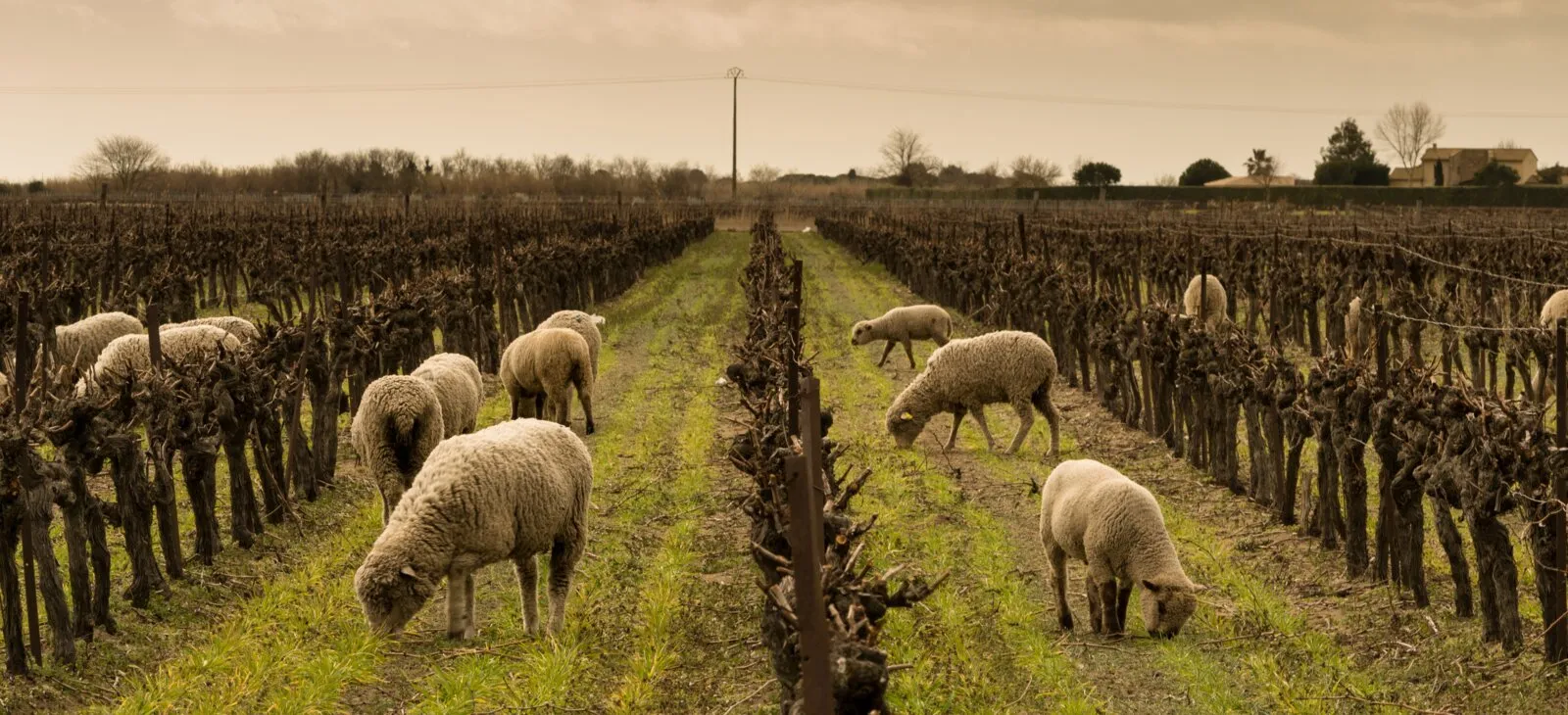
We believe that the agriculture of tomorrow will be made of many systems, and that everyone will contribute their own touch and innovation to shape it (weeding between vines with sheep or with hens? What kind of hedges for what size of field? Transplanting rice seedlings after 8 days rather than 30? Growing walnut trees above apple trees?).
Above all, we believe that powerful new ideas can grow out of collaboration and of sharing techniques and experience.
We are convinced that the farming world is ready to take up this challenge, and that nobody is more passionate than a farmer when it comes to imagining new ways of doing the job.
We are certain that the farming world is ready to change, share its experience, learn and exchange, as long as it is given the means to do so, in a climate of trust and goodwill rather than preconceptions and suspicion.
We think that technical solutions, whatever their nature, are only tools. What matters is the purpose and the way they are used.
Our goal is therefore to make it easier to share all the practices and innovations that enable, and will enable, an agriculture that performs even better and is more respectful of nature and of its inherently limited resources.
Update (24 June 2019) — The second article in this series is here!